Overview:
The Parent Letter is a personalized letter from the teacher to inform each student’s parents of their known and unknown skills. It includes each student's test results (correct items, incorrect items, and the grade, if Grade Scales were set up). To avoid students memorizing the items in test order, correct and incorrect items will be shown in alphabetical order. If an item was not tested, it will be optional to include it on the Parent Letter. Question and Summary Notes (teacher observations during testing) can also be included.
The Parent Letter can be printed in English or Spanish and saved as a Word.doc or PDF. The Spanish translation is available as a template, but the Parent Letter can be written by the teacher in any language and then saved as a template. It can also be printed in color. All tests from a particular tab can be included, and there is also the option to omit certain tests from the Parent Letter. The test session date will be included by default, but an option is available to not include it on the Parent Letter.
Table of Contents:
- Running the Parent Letter
- Explaining the Test Table
- Including all tests in one Parent Letter
- Fixing the Test Title Repeating under Correct and Incorrect
- Modifying the Parent Letter Template (message to parents)
- Creating a new template in another language
Running the Parent Letter
1. Log into the Admin Dashboard and select Data from the column on the left side of the application window.
2. Select either the Classes or Students level of the hierarchy.
3. Select your desired class (or student) and click on the blue Run Reports button (see Image 1).
4. Select Parent Letter from the pop-up that appears.
5. Choose your desired settings (see Image 2):
- The drop-down menus allow you to select a different:
- Class (if applicable)
- Student
- Subject Tab
- Show - Allows you to toggle the report to display the notes and/or summary that were added by the teacher on your Parent Letter. You can also choose to print the Parent Letter in color.
Note: You can only print the Parent Letter in color if you have toggled Grades and In color. - Results - Allows you to include grades, skipped questions, session date, and include answers on the Parent Letter. Additionally, you can toggle to choose which test session will be displayed.
- Grades: Select Grades to include Grade Scales if they have been set up.
- Skipped Questions: Includes questions that were skipped during testing.
Note: Skipped questions are marked as incorrect. - Session Date: Check to include the date of the test session
- Choose Session: When Choose Session is checked, a new column, View Session date as of will appear with two options for selecting the test session date. The test session/marking period dates are globally applied to all tests with a checkbox to the left of the test name but can be customized for each test.
- Date - Select a specific date using a calendar picker. The report will run with the latest test session on or prior to that date.
Note: If there are no prior test sessions, the test will not appear on the report for that student. - Marking Period - The report will run using the last date of the selected marking period. The actual test date will be visible.
- Date - Select a specific date using a calendar picker. The report will run with the latest test session on or prior to that date.
- Parent Template - Allows you to include a message to the parents on the letter. Click on Parent Message to edit the template.
Note: District Managed Subject Tabs may contain templates that are only managed by a District Administrator and cannot be modified by a Teacher, Specialist, Pre-Assess, or School Admin Account.
If you have a District Admin Account, you can create and edit universal message for District Managed Subject Tabs by following the instructions outlined on our District Parent Letter support page.
6. Once the desired settings are selected, click the blue VIEW PARENT LETTER (see Image 2).
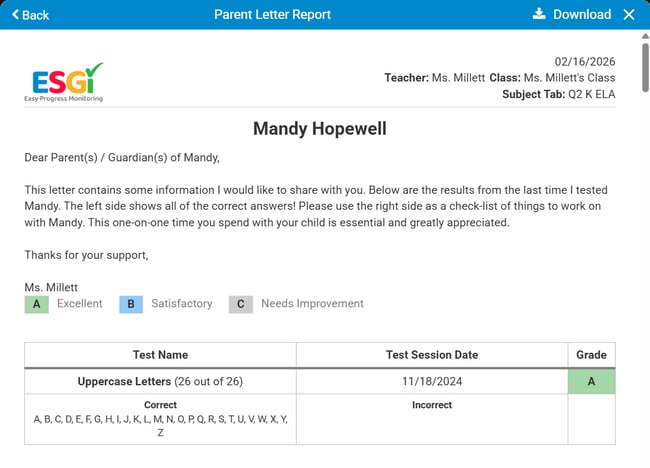
7. A Parent Letter preview page will appear with the selected options from step 5 applied (see Image 3).
8. To download, click Download at the top right of the Parent Letter preview page (see Image 3), then select PDF, Google PDF, Word, Google Doc, ZIP, or Google ZIP as your file type.
Image 1
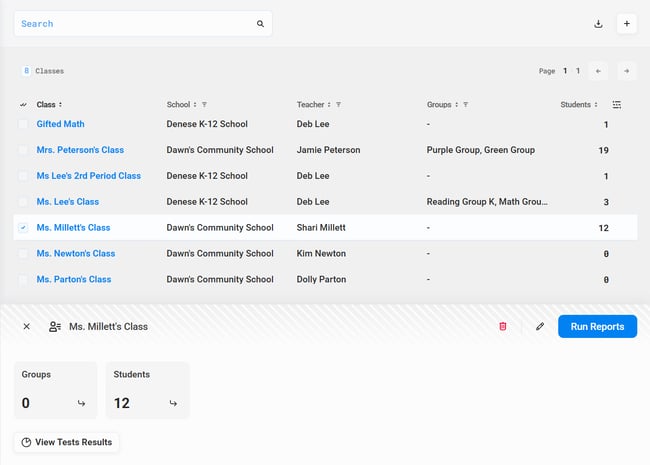
Image 2
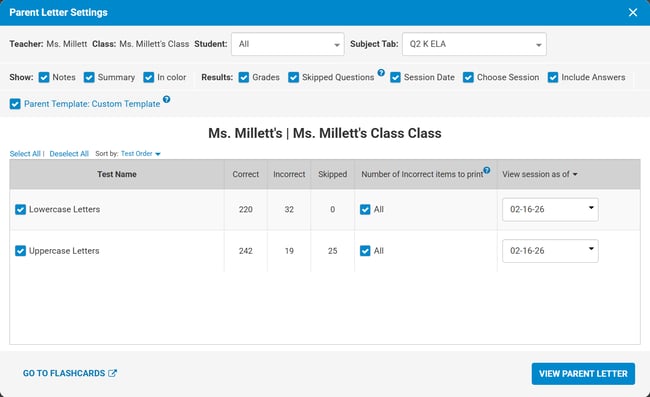
Image 3
Explaining the Test Table
- If All Students are selected, the Correct, Incorrect and Skipped counts are for all students.
-
Questions that were skipped and/or not given during testing are separated from the incorrect answers, however, are still counted as incorrect. To not include the Skipped Questions, uncheck the box.
- For a Single Score test, N/A will display for "Incorrect" and "Skipped" as there is only one question on this test type.
-
The number of incorrect items to print can be "All" or only a certain number. Deselect "All" and enter the desired number to print.
- Once a Subject Tab is selected, all tests on that tab will display. To not include a test on a Parent Letter, uncheck the box (see Image 2). You can choose to sort tests in Test Order or Alphabetical.
Including all tests in one Parent Letter
The tests that appear on a Parent Letter (and all other reports) depend on the Subject Tab the tests are on. To print the Parent Letter with all tests, create your own Subject Tab with all the tests that you want to appear together on the Parent Letter. Tests can appear in more than one Subject Tab, and the same data is reported on each if the exact same test is used.
Fixing the Test Title Repeating under Correct and Incorrect
If the Question Name appears as the answer to the question on the Parent Letter under the “Correct” and “Incorrect” headings, then the author used the Test Title for the Question Name of each question when creating the test. This field should be the name of the question and can be edited only by the test author. The Edit/Modify a Test Support Page provides step-by-step instructions.
The Question Name is usually the answer to the question (the sight word, the pattern, etc.), but it can be the question itself. When the answer is the sight word, the letter, the sound, etc., the Parent Letter is easy to understand. If the Question Name is the question itself (i.e., "What word is this"), then it will be difficult for the parent to understand. With addition and subtraction, the Question Name should be the equation, such as 2 + 5, instead of just 7.
It is important to keep this short since they will print on the Parent Letter. Longer names make the report very difficult to read.
Modifying the Parent Letter Template (message to parents)
The text on each Parent Letter Template can be edited but must be manually edited in each language. ESGI does not automatically translate templates in the Admin Version, so each Parent Letter Template must manually be edited for all languages (if your teachers have multiple languages in their class).
The Parent Letter Template can be edited by an Admin using the Message Template option of the Parent Letter Settings page. A District Admin can create a universal message for all teachers to use within their District Admin account. See District Parent Letter for complete details.
Please follow these steps to customize the Parent Message:
1. Click the blue Parent Template text located underneath Show: in the Parent Letter Settings popup (see Image 2).
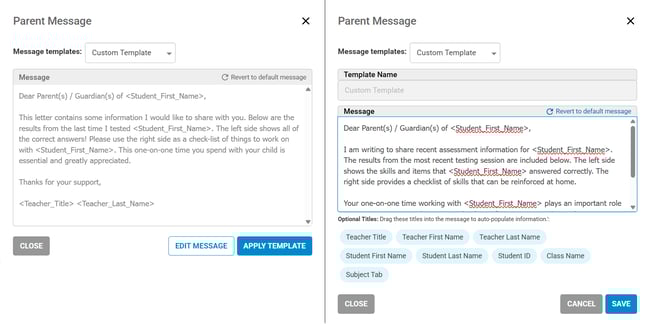
2. Select the template from the drop down that you wish to modify, then click on EDIT MESSAGE (see Image 4). This will allow you to make changes to the Parent Letter message text.
Please Note: ESGI does not automatically translate, so any language template must be edited in entirely in that language. Do not edit the symbols or text within the < and >; they are needed to populate the Parent Letters.
3. Drag and drop optional titles to auto-populate information.
4. Click SAVE when finished editing (see Image 4).
5.Click the blue VIEW PARENT LETTER button at the bottom right of the Parent Letter Settings popup (see Image 2).
6. Your custom template will now be applied to your Parent Letter Report.
7. To download, click Download at the top right of the Parent Letter preview page (see Image 3), then select PDF, Google PDF, Word, Google Doc, ZIP, or Google ZIP as your file type.
Image 4
Creating a new template in another language
1. Click the blue Parent Message text located underneath Show: in the Parent Letter Settings popup (see Image 2).
2.Click on the Message Templates dropdown (see Image 4), then click Add new... to manually create and save a new custom template for the desired language.
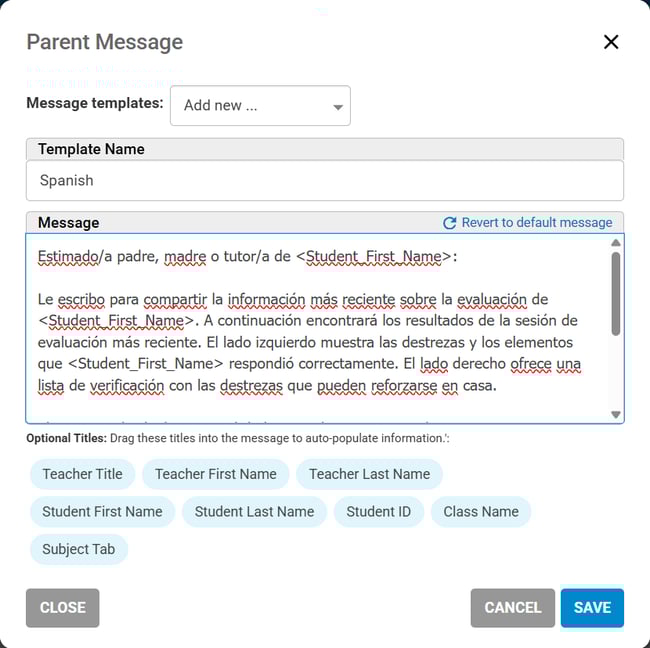
3. Under Template Name, (see Image 5) type in the name of the language that this template is for (Spanish, French, Arabic, Chinese, etc.).
4. Under Message (see Image 5), enter the desired language text for the Parent Letter in the box (we recommend translating using a tool such as Google Translate, Microsoft Co-Pilot, or ChatGPT, then copying/pasting it into ESGI. You could also use another language keyboard if available).
-
Our Parent Letter Translations Support Page provides English translations to Tagalog, Mandarin, Vietnamese, German and Russian.
-
Do not edit the symbols or text within the < and >, as they are needed to populate the Parent Letters. Editing the font is optional.
5. When your translated template is complete, click the blue SAVE button (see Image 5) to save your template and automatically apply it to the Parent Letter.
7. Your custom language template will now appear on the Message Templates dropdown, for future usage.
Note: If you wish to switch templates, click on the Message Templates Dropdown.
8. Click the blue VIEW PARENT LETTER button at the bottom right of the Parent Letter Settings popup (see Image 2).
9. Your custom language template will now be applied to your Parent Letter Report.
10. To download, click Download at the top right of the Parent Letter preview page (see Image 3), then select PDF, Google PDF, Word, Google Doc, ZIP, or Google ZIP as your file type.
Image 5